


This article is part of a series that analyzes key themes from L.E.K. Consulting’s eighth annual U.S. manufacturer survey. It discusses how procurement and supply chain best practices are evolving to meet new realities.
U.S. manufacturing firms have faced a series of supply chain disruptions in recent years, from COVID-triggered input availability challenges to navigating the current tariff environment. Together these disruptions have added a growing element of uncertainty to the procurement process and caused companies — both large and small — to reassess their procurement and supply chain strategies.
Now, as domestic manufacturers look to build resiliency into their supply chains, a shift is taking place toward greater reshoring, the prioritization of energy security and a need for supplier diversity — all of which present opportunities for manufacturers to unlock new growth.
But while there are now macro tailwinds toward greater domestic production, companies still need to manage through the uncertainty associated with tariffs and international trade.
Optimize across the value chain
One of the best ways to mitigate the impact of tariffs is to have a very strong, cost-efficient, end-to-end supply chain. To that end, L.E.K. has developed an assessment and mitigation framework to support U.S. companies as they look to optimize for each component across the value chain. Our mitigation plan ensures companies have transparency all the way through their Tier 1, Tier 2 and Tier 3 suppliers.
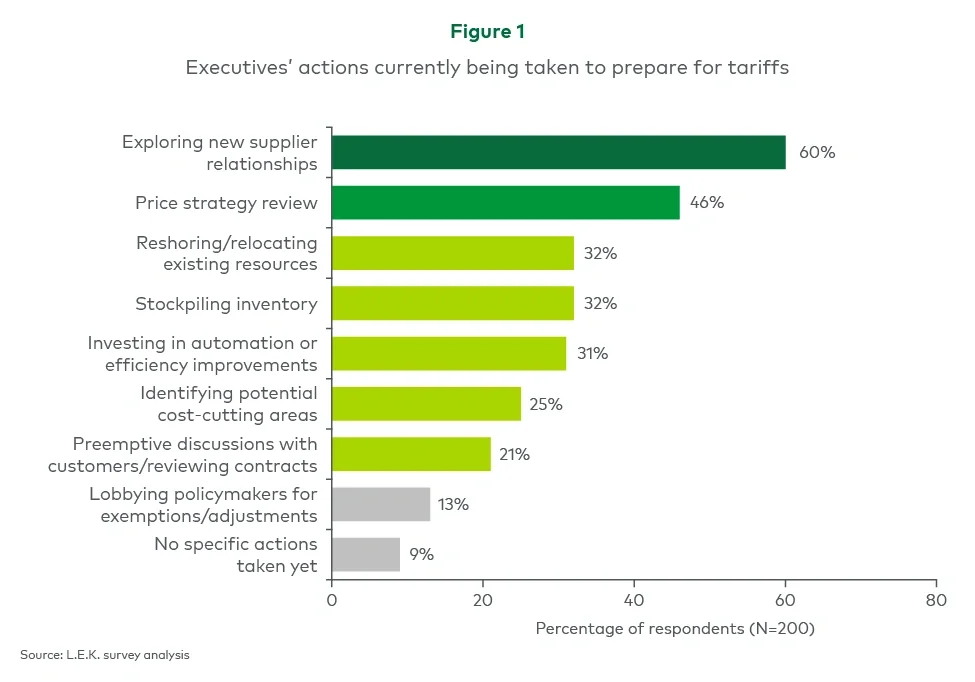
With prevailing costs and import duties for raw materials and finished goods in flux, it is also incumbent on manufacturers to ensure procurement and supply chain continuity and flexibility. Indeed, mitigating negative impacts from tariffs and addressing trade controls/sanctions are among the top concerns for companies in the near term, while more costly and time-intensive initiatives (e.g., relocating manufacturing, shifting supply chains) are being held until the longer-term outlook and any related implications become clearer. This is leading to manufacturers prioritizing the vetting of potential new suppliers and reviewing their respective in-house pricing strategies to ensure operating teams have the flexibility to respond to any changes in market conditions (see Figure 1).